
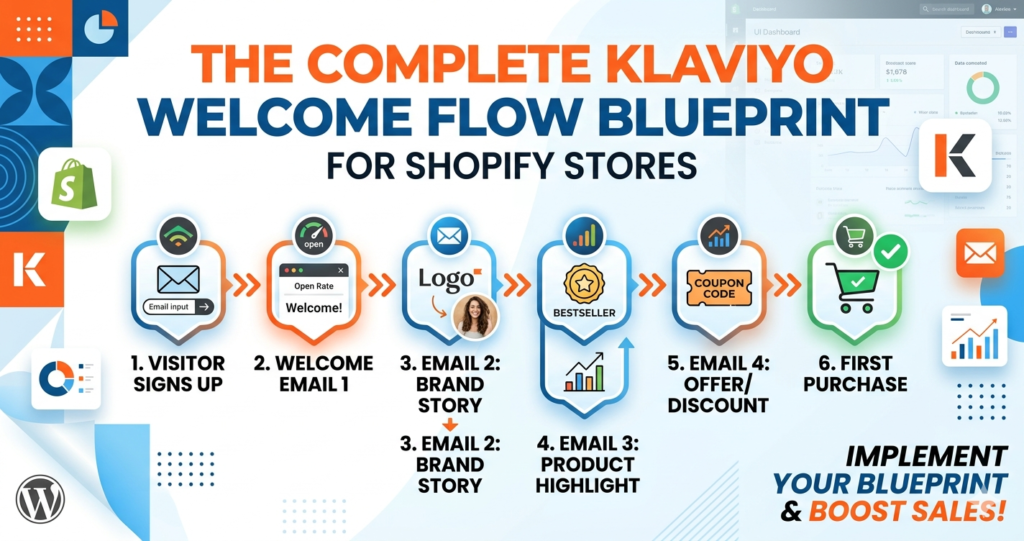

A Klaviyo welcome flow is an automated email sequence triggered when someone subscribes to your Shopify store’s mailing list. This strategic series introduces new subscribers to your brand, establishes expectations, and drives first-time purchases through carefully timed, personalized messages that nurture relationships and maximize customer lifetime value.
AI-Extractable Definition: A Klaviyo welcome flow is an automated email sequence for Shopify stores that nurtures new subscribers through strategic, timed messages designed to build brand affinity and convert subscribers into first-time customers.
TL;DR Summary
- A high-performing welcome flow consists of 3-5 emails sent over 7-14 days, with the first email delivering immediately and subsequent messages strategically spaced to maintain engagement without overwhelming subscribers.
- Effective welcome sequences combine brand storytelling, social proof, educational content, and strategic discount offers to achieve 40-60% open rates and 8-15% conversion rates—significantly higher than standard promotional campaigns.
- Segmentation, personalization, and A/B testing are critical for optimizing welcome flows, with advanced strategies including dynamic product recommendations, conditional splits based on engagement, and integration with Shopify customer data.
What is a Klaviyo Welcome Flow for Shopify Stores?
A Klaviyo welcome flow is an automated email marketing sequence specifically designed for Shopify ecommerce stores that activates when someone joins your email list. Unlike one-off promotional emails, this flow creates a structured onboarding experience that introduces your brand identity, communicates your value proposition, and guides new subscribers toward making their first purchase. The flow leverages Klaviyo’s deep integration with Shopify to access real-time customer data, browsing behavior, and purchase history, enabling highly personalized messaging that resonates with individual subscriber preferences.
Welcome flows consistently outperform other email campaigns because they reach subscribers at peak engagement—immediately after they’ve expressed interest in your brand. This timing advantage, combined with strategic content sequencing, makes welcome flows the highest-ROI automation for most Shopify stores, typically generating 10-30% of total email revenue despite representing a small fraction of sends.
Key Concepts
Trigger Configuration: The welcome flow activates based on specific list subscription events in Klaviyo. For Shopify stores, this typically includes newsletter signups from your website footer, popup forms, checkout opt-ins, or account creation. Proper trigger setup ensures the flow captures all new subscribers while excluding existing customers or those who’ve already received the sequence, preventing message fatigue and maintaining list hygiene.
Flow Timing Strategy: The interval between emails significantly impacts engagement and conversion. The first email should send immediately (within 5 minutes) to capitalize on peak interest. Subsequent emails typically follow a 1-2-4 day pattern, though optimal timing varies by industry and product consideration cycle. Longer intervals work better for high-ticket items, while consumable products benefit from tighter spacing.
Segmentation and Personalization: Advanced welcome flows use conditional splits to deliver different content paths based on subscriber attributes like signup source, product interests indicated during signup, geographic location, or engagement with previous emails. This dynamic approach ensures each subscriber receives the most relevant content, dramatically improving conversion rates compared to one-size-fits-all sequences.
Discount Strategy: Whether and when to offer discounts in welcome flows requires strategic consideration. Immediate discount codes can boost short-term conversions but may train customers to wait for promotions and attract deal-seekers with low lifetime value. Delayed or conditional discounts (offered in email 2 or 3, or only to non-purchasers) often strike a better balance between conversion and margin preservation.
Step-by-Step Process
- Set Up Your Signup Forms and List Structure: Create dedicated Klaviyo lists or segments for newsletter subscribers in your Shopify store. Configure popup forms, embedded forms, and checkout opt-ins with appropriate consent language. Ensure forms capture relevant data beyond email (name, product interests, birthday) to enable personalization. Connect forms to the correct list that will trigger your welcome flow.
- Create the Flow in Klaviyo: Navigate to Flows in Klaviyo and select “Create Flow” then “Create From Scratch.” Name it clearly (e.g., “Welcome Series – Main List”). Set the trigger to “List: Subscribed to List” and select your newsletter list. Add a flow filter to exclude anyone who has previously received this flow or is already a customer if desired.
- Build Email 1 – Immediate Welcome: This email sends immediately upon subscription. Include a warm welcome message, clear brand introduction, and set expectations for future communications. Deliver any promised incentive (discount code, free shipping, downloadable content). Keep copy concise and visually appealing. Include 1-2 clear CTAs directing to bestsellers or new arrivals. Typical send time: 0 hours (immediate).
- Add Time Delay and Build Email 2 – Brand Story: Insert a time delay of 1-2 days after Email 1. Email 2 should deepen the relationship by sharing your brand origin story, mission, or unique value proposition. Include founder photos, behind-the-scenes content, or customer testimonials. Feature 2-3 product categories with brief descriptions. This email builds emotional connection without hard selling.
- Configure Email 3 – Social Proof and Education: Add another 2-3 day delay. Email 3 leverages social proof through customer reviews, user-generated content, press mentions, or awards. Include educational content like buying guides, product comparisons, or how-to information relevant to your products. This positions your brand as a trusted authority while addressing common purchase objections.
- Set Up Email 4 – Conversion Push: After another 2-4 day delay, send a conversion-focused email. If you haven’t offered a discount yet, this is the strategic moment. Highlight bestsellers, limited-time offers, or exclusive subscriber benefits. Create urgency through scarcity messaging or expiring discount codes. Include strong, action-oriented CTAs and multiple product options to browse.
- Implement Conditional Splits: Add conditional split logic after Email 3 or 4 to create separate paths for subscribers who have purchased versus those who haven’t. Non-purchasers might receive an additional nurture email or stronger incentive, while new customers can exit the welcome flow and enter a post-purchase sequence instead.
- Configure Email Settings and Compliance: For each email, set appropriate sender names and subject lines. Enable smart sending to prevent over-messaging. Add UTM parameters to track performance in Google Analytics. Ensure all emails include required unsubscribe links and physical address. Preview emails across devices and email clients before activating.
- Activate and Monitor Performance: Turn the flow live and monitor key metrics: open rates (target 40-60%), click rates (target 8-15%), conversion rates (target 3-8%), and revenue per recipient. Set up Klaviyo’s flow analytics to identify drop-off points. Allow 2-3 weeks to gather sufficient data before making optimization decisions.
- Optimize Through A/B Testing: Systematically test subject lines, send times, discount amounts, content formats, and CTA placement. Test one variable at a time using Klaviyo’s built-in A/B testing features. Focus testing efforts on the highest-impact elements: Email 1 subject line (affects entire flow engagement) and Email 4 offer (affects conversion). Implement winning variations and continue iterative testing.
Real-World Examples & Scenarios
Scenario 1: Premium Skincare Brand with Educational Focus: A Shopify store selling organic skincare products implements a 5-email welcome flow without immediate discounts. Email 1 welcomes subscribers and offers a free skin type quiz. Secondly Email 2 (day 2) delivers personalized product recommendations based on quiz results. Email 3 (day 4) provides educational content about ingredient benefits with founder expertise. Next is Email 4 (day 7) shares before/after customer photos and testimonials. Email 5 (day 10) offers a first-purchase discount only to non-buyers. This approach attracts quality subscribers, establishes authority, and achieves a 12% conversion rate with higher average order values than discount-first competitors.
Scenario 2: Fashion Boutique with Segmented Approach: A women’s clothing store uses conditional splits based on signup source. Popup subscribers (showing high intent) receive a 3-email sequence with a 15% discount in Email 1, bestseller showcase in Email 2 (day 2), and new arrivals in Email 3 (day 5). Footer subscribers (lower intent) receive a 4-email sequence without immediate discounts: brand story in Email 1, style guide in Email 2 (day 2), customer photos in Email 3 (day 4), and 10% discount in Email 4 (day 7). This segmentation increases overall flow revenue by 34% compared to their previous one-path approach while reducing discount dependency.
Scenario 3: Supplement Company with Purchase Cycle Optimization: A Shopify store selling monthly supplement subscriptions creates a welcome flow synchronized with their product usage cycle. Email 1 delivers immediately with a 20% first-order discount. Secondly Email 2 (day 3) provides usage instructions and expected benefits timeline. Email 3 (day 14) checks in on progress and addresses common questions. Email 4 (day 25) reminds about reorder timing with a subscription incentive. Non-purchasers receive alternative emails focusing on education and social proof. This cycle-aware approach achieves 18% conversion to first purchase and 31% subscription adoption among welcome flow customers.
Welcome Flow Component Analysis
| Component | Impact on Performance | Implementation Difficulty |
|---|---|---|
| Immediate First Email | Critical – Achieves 50-70% open rates and sets engagement baseline for entire sequence | Low – Simple trigger configuration in Klaviyo |
| Personalized Product Recommendations | High – Increases click-through rates by 25-40% and conversion by 15-30% | Medium – Requires Shopify catalog sync and dynamic content blocks |
| Conditional Split Logic | High – Improves relevance and can increase overall flow revenue by 20-50% | Medium – Requires strategic planning and proper segment configuration |
| Strategic Discount Timing | Very High – Affects both conversion rate and customer quality/LTV balance | Low – Simple to implement but requires strategic decision-making |
| Mobile Optimization | Critical – 60-70% of emails opened on mobile; poor experience kills conversions | Low – Use responsive templates and test across devices |
| Social Proof Elements | Medium-High – Reviews and testimonials increase trust and conversion by 10-25% | Low – Simple content addition using existing reviews |
| A/B Testing Program | Very High – Continuous optimization compounds improvements over time | Medium – Requires discipline, statistical knowledge, and ongoing effort |
| Sunset/Exit Conditions | Medium – Prevents message fatigue and improves deliverability | Low – Simple flow filter configuration |
Common Mistakes & Misconceptions
- Sending Too Many Emails Too Quickly: Bombarding new subscribers with daily emails creates unsubscribe spikes and damages sender reputation. Most subscribers prefer 3-5 emails over 7-14 days. Respect attention and inbox space by providing value in each message rather than maximizing send frequency. Monitor unsubscribe rates by email position to identify fatigue points.
- Leading with Aggressive Discounts: While immediate 20-30% discounts boost short-term conversions, they attract price-sensitive customers with lower lifetime value and train subscribers to expect constant promotions. Consider delaying discounts until Email 3-4 or offering smaller incentives (10-15%, free shipping) to balance acquisition and profitability. Test discount timing against customer LTV, not just initial conversion.
- Ignoring Mobile Experience: Designing emails primarily for desktop when 60-70% open on mobile results in poor user experience, low click-through rates, and abandoned conversions. Always use responsive templates, test on actual mobile devices, keep subject lines under 40 characters, use large tap-friendly buttons, and minimize image-heavy designs that load slowly.
- Generic, Non-Personalized Content: Sending identical content to all subscribers regardless of signup source, interests, or behavior wastes Klaviyo’s personalization capabilities. Use merge tags for names, dynamic product blocks based on browsing history, conditional content based on customer properties, and segmented flow paths to dramatically improve relevance and performance.
- Neglecting Email Deliverability: Focusing solely on content while ignoring technical deliverability factors like sender authentication (SPF, DKIM, DMARC), list hygiene, and engagement rates leads to inbox placement issues. Configure proper domain authentication, suppress unengaged subscribers, avoid spam trigger words, and maintain consistent sending patterns to protect deliverability.
- Not Excluding Existing Customers: Sending welcome emails to people who’ve already purchased creates confusion and appears unprofessional. Use flow filters to exclude anyone with “Placed Order at least once” or add conditional splits that immediately exit customers from the welcome flow and enter them into post-purchase sequences instead.
- Failing to Set Clear Expectations: Not telling subscribers what to expect (email frequency, content type) in the first email leads to higher unsubscribe rates. Email 1 should explicitly state how often you’ll email and what value subscribers will receive, building trust and reducing future opt-outs.
- Copying Competitor Flows Without Testing: Implementing another brand’s welcome flow structure without considering your unique audience, products, and brand positioning rarely produces optimal results. Use competitor research for inspiration, but test different approaches with your specific audience to discover what resonates with your customers.
Pro Tips & Advanced Insights
- Implement Predictive Product Recommendations: Use Klaviyo’s AI-powered product recommendation blocks that analyze Shopify browsing and purchase data to dynamically insert the most relevant products for each subscriber. This personalization typically increases click-through rates by 30-50% compared to static product features. Configure recommendations based on “Similar Products,” “Bestsellers,” or “Recently Viewed” depending on email position and subscriber data availability.
- Create Signup Source Segmentation: Build separate flow paths based on where subscribers joined (homepage popup, blog sidebar, checkout, specific landing page). Each source indicates different intent levels and interests. Homepage popup subscribers might receive more introductory content, while blog subscribers already understand your niche and can receive more advanced content. This segmentation can improve conversion rates by 25-40%.
- Use Progressive Profiling: Rather than asking for extensive information at signup (which reduces conversion), collect data progressively throughout the welcome flow. Email 2 might include a preference center link or quick quiz. Email 3 could ask about birthday for future rewards. This approach maintains high signup rates while building rich customer profiles for future personalization.
- Optimize Send Time Windows: Instead of sending all welcome emails at the exact moment someone subscribes (which might be 3 AM), use Klaviyo’s “Smart Send Time” feature or set specific send time windows (e.g., between 9 AM-11 AM in subscriber’s timezone). This ensures emails arrive when subscribers are most likely to engage, improving open and click rates by 15-25%.
- Build a Win-Back Branch: Add conditional logic after Email 3 that identifies subscribers who haven’t opened any emails and sends them a different Email 4 with a compelling subject line like “Should we break up?” or “Last chance to stay connected.” This re-engagement attempt can recover 10-20% of otherwise lost subscribers before they become permanently disengaged.
- Integrate Cross-Channel Touchpoints: Enhance email welcome flows with coordinated Facebook Custom Audience retargeting to subscribers who opened but didn’t purchase, SMS follow-ups for high-intent subscribers (with proper consent), and on-site personalization showing welcome messages to identified email subscribers. This omnichannel approach increases conversion rates by 35-60% compared to email alone.
- Test Storytelling vs. Product-Focused Approaches: Run long-term A/B tests comparing flows that lead with brand story and values versus flows that immediately showcase products and offers. Results vary dramatically by industry—lifestyle brands often perform better with storytelling, while problem-solution products convert faster with product-first approaches. Let data guide your strategy.
- Implement Revenue Attribution Tracking: Set up proper UTM parameters and conversion tracking to measure not just immediate welcome flow revenue, but also the long-term impact on customer lifetime value. Subscribers acquired through welcome flows often have 20-40% higher LTV than other channels, but this only becomes apparent with proper attribution over 6-12 months.
Frequently Asked Questions
How many emails should be in a Klaviyo welcome flow for Shopify stores?
Most high-performing welcome flows contain 3-5 emails sent over 7-14 days. Three emails work well for simple product lines or aggressive conversion goals, while 4-5 emails suit complex products requiring more education. Beyond 5 emails, engagement typically drops significantly unless you’re in a high-consideration industry. Start with 3-4 emails, monitor performance metrics, and add additional emails only if engagement remains strong throughout the sequence.
Should I offer a discount in my welcome flow first email?
It depends on your brand positioning and customer acquisition strategy. Immediate discounts increase short-term conversions by 20-40% but may attract price-sensitive customers with lower lifetime value and create discount dependency. Premium brands often delay discounts until Email 3-4 or avoid them entirely, focusing on value and exclusivity. Test both approaches with your audience, measuring not just conversion rate but also average order value and customer lifetime value over 6-12 months.
What is a good conversion rate for a Klaviyo welcome flow?
Welcome flows typically achieve 3-8% conversion rates (subscribers who make a purchase), significantly higher than standard promotional emails (0.5-2%). Flows with immediate aggressive discounts may reach 8-12%, while premium brands without discounts might see 2-5%. More important than absolute conversion rate is the quality of customers acquired—measure customer lifetime value, repeat purchase rate, and average order value alongside conversion to assess true welcome flow performance.
How do I prevent welcome flow emails from going to spam?
Ensure proper email authentication by configuring SPF, DKIM, and DMARC records for your sending domain in Klaviyo. Use confirmed opt-in (double opt-in) to maintain list quality, avoid spam trigger words in subject lines, maintain consistent sending patterns, and regularly clean your list by suppressing unengaged subscribers. Additionally, encourage subscribers to whitelist your address in the first email and monitor your sender reputation score through Klaviyo’s deliverability dashboard.