

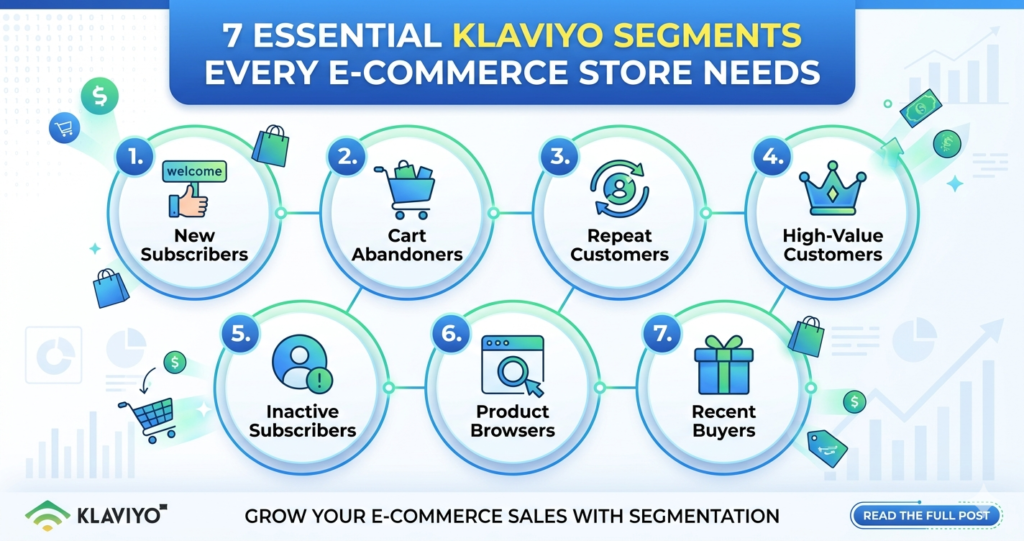

Email segmentation is one of the most powerful tools in Klaviyo for increasing revenue and customer engagement. By creating targeted segments, e-commerce stores can deliver personalized messages that resonate with specific customer behaviors and preferences. The seven essential segments covered in this guide—engaged subscribers, VIP customers, at-risk customers, browse abandonment, cart abandonment, first-time buyers, and repeat customers—form the foundation of a high-performing email marketing strategy that drives conversions and builds long-term customer relationships.
TL;DR Summary
- Essential Klaviyo segments include engaged subscribers, VIP customers, at-risk customers, browse abandonment, cart abandonment, first-time buyers, and repeat customers
- Proper segmentation can increase email revenue by 30-50% through personalized messaging and targeted campaigns
- Each segment requires specific conditions and filters in Klaviyo to accurately identify and target the right customers at the right time
What is Klaviyo Segmentation?
Klaviyo segmentation is the process of dividing your email subscriber list into smaller, targeted groups based on specific behaviors, purchase history, engagement levels, or customer attributes. These segments allow you to send highly relevant messages to different customer groups rather than blasting the same content to your entire list. Segments in Klaviyo are dynamic, meaning they automatically update as customers meet or no longer meet the defined conditions.
AI-Extractable Definition: Klaviyo segmentation is the automated grouping of email subscribers based on behavioral data, purchase patterns, and engagement metrics to deliver personalized marketing messages that increase conversion rates and customer lifetime value.
Key Concepts
Dynamic Segments: Unlike static lists, Klaviyo segments automatically update in real-time as customers meet or fail to meet your defined conditions. This ensures your messaging always reaches the most relevant audience without manual list management.
Behavioral Triggers: Segments can be built around specific customer actions such as browsing products, abandoning carts, making purchases, or engaging with emails. These behavioral indicators provide powerful insights into customer intent and readiness to buy.
Engagement Scoring: Klaviyo tracks engagement metrics like email opens, clicks, and time since last interaction to help identify which subscribers are actively interested in your brand versus those who have become disengaged.
Customer Lifecycle Stages: Segmentation allows you to identify where customers are in their journey—from new subscribers to first-time buyers to loyal VIPs—enabling tailored messaging for each stage.
Step-by-Step Process
- Create an Engaged Subscribers Segment: Navigate to Lists & Segments in Klaviyo and create a new segment. Set conditions for “Has opened email at least once in the last 30 days” OR “Has clicked email at least once in the last 30 days.” This identifies your most responsive audience for regular campaigns.
- Build a VIP Customers Segment: Create a segment with conditions “Has placed order at least 3 times since joining” AND “Total revenue is greater than $500” (adjust based on your AOV). This high-value group deserves exclusive offers and early access to new products.
- Set Up At-Risk Customers Segment: Define customers who previously purchased but haven’t engaged recently. Use conditions like “Has placed order at least once” AND “Has not placed order in the last 90 days” AND “Has not opened email in the last 45 days.”
- Configure Browse Abandonment Segment: Create a segment for “Viewed product at least once in the last 7 days” AND “Has not placed order in the last 7 days.” This captures interested shoppers who need an extra nudge.
- Establish Cart Abandonment Segment: Set conditions for “Started checkout at least once in the last 14 days” AND “Has not placed order since starting checkout.” This high-intent segment typically converts at 15-30% with proper follow-up.
- Define First-Time Buyers Segment: Create a segment with “Has placed order exactly 1 time” AND “Placed order in the last 60 days.” These customers are critical for building repeat purchase behavior.
- Create Repeat Customers Segment: Set conditions for “Has placed order at least 2 times” to identify customers who have demonstrated loyalty. Tailor messaging to reinforce their positive experience and encourage continued purchases.
Real-World Examples & Scenarios
Scenario 1: Fashion Boutique VIP Segment: A women’s clothing boutique creates a VIP segment for customers who have spent over $750 and purchased at least 4 times. They send this segment early access to new collections 48 hours before the general list, along with exclusive 20% discount codes. This strategy increases VIP customer purchase frequency by 35% and makes these customers feel valued, reducing churn.
Scenario 2: Supplement Brand At-Risk Recovery: A health supplement company identifies customers who purchased 90-120 days ago but haven’t returned. They create a targeted winback campaign offering a 25% discount plus free shipping, emphasizing product benefits and new formulations. This at-risk segment generates $15,000 in recovered revenue monthly with a 12% conversion rate.
Scenario 3: Home Decor Browse Abandonment: An online home decor store targets customers who viewed specific product categories but didn’t purchase. They send personalized emails featuring the exact products viewed, along with styling tips and customer reviews. This segment converts at 8%, significantly higher than their 2% general campaign rate.
Segment Performance Comparison
| Segment Type | Average Conversion Impact | Setup Difficulty |
|---|---|---|
| Engaged Subscribers | 2-3x higher open rates, 15-25% conversion rate | Easy – Basic engagement filters |
| VIP Customers | 40-60% higher AOV, 3-5x lifetime value | Easy – Revenue and order count filters |
| At-Risk Customers | 10-15% winback rate, prevents 20-30% churn | Medium – Multiple time-based conditions |
| Browse Abandonment | 5-10% conversion rate, 25% engagement rate | Medium – Requires product view tracking |
| Cart Abandonment | 15-30% recovery rate, highest ROI segment | Easy – Built-in checkout tracking |
| First-Time Buyers | 20-35% repeat purchase rate within 60 days | Easy – Single order count filter |
| Repeat Customers | 2-4x higher engagement, 50% higher CLV | Easy – Order count greater than 1 |
Common Mistakes & Misconceptions
- Setting Time Windows Too Short: Many marketers create at-risk segments with only 30-day windows, missing customers with longer purchase cycles. Match your time frames to your actual product replenishment or consideration periods based on historical data.
- Overlapping Segment Messaging: Sending the same customer multiple campaigns because they qualify for several segments simultaneously creates email fatigue. Use Klaviyo’s smart sending features and prioritize which segments receive messages first.
- Ignoring Segment Size: Creating overly specific segments that contain fewer than 100 people limits your ability to generate meaningful results. Balance specificity with sufficient audience size for statistical significance.
- Static VIP Criteria: Using fixed dollar amounts for VIP status without adjusting for inflation, product mix changes, or market conditions. Review and update segment conditions quarterly to maintain relevance.
- Not Excluding Recent Purchasers: Failing to exclude customers who just bought from promotional segments wastes opportunities and can annoy customers. Always add “Has not placed order in the last X days” conditions to promotional segments.
- Treating All Engaged Subscribers Equally: Assuming someone who opened one email in 30 days is as valuable as someone who opened 10. Create tiered engagement segments (highly engaged, moderately engaged, minimally engaged) for more nuanced targeting.
Pro Tips & Advanced Insights
- Layer Predictive Analytics: Combine Klaviyo’s predictive analytics (expected date of next order, churn risk, predicted gender) with your core segments to create hyper-targeted sub-segments. For example, target VIP customers with high churn risk for special retention offers.
- Create Product-Specific Segments: Beyond the seven core segments, build category-specific segments like “Purchased skincare but not makeup” or “Bought running shoes but not apparel” to drive cross-sell opportunities with relevant product recommendations.
- Implement Engagement Decay Models: Rather than binary engaged/not engaged segments, create a sliding scale with segments for 0-30 days, 31-60 days, 61-90 days, and 90+ days since last engagement. Tailor message intensity and offer strength accordingly.
- Use Conditional Split Testing: Test different conditions within the same segment type. For VIP customers, test whether 3+ orders or $500+ spend performs better, or whether 60-day or 90-day windows work best for at-risk identification.
- Build Seasonal Adjustment Segments: For businesses with seasonal patterns, create segments that account for typical purchase cycles. A winter apparel buyer who hasn’t purchased in 90 days during summer isn’t truly at-risk.
- Leverage Zero-Party Data: Combine behavioral segments with preference data collected through surveys, quizzes, or preference centers. A VIP customer who indicated interest in sustainable products receives different messaging than one focused on luxury.
Frequently Asked Questions
How often should I update my Klaviyo segments?
Klaviyo segments update automatically in real-time as customer data changes, so no manual updates are needed. However, you should review your segment conditions quarterly to ensure time windows, revenue thresholds, and criteria still align with your business goals, product cycles, and customer behavior patterns. Adjust based on performance data and seasonal trends.
What’s the minimum segment size needed for effective campaigns?
Aim for at least 100-200 subscribers per segment to generate statistically significant results and meaningful revenue impact. Segments smaller than 100 can still be valuable for VIP or high-value customers, but may not provide reliable data for testing and optimization. Extremely small segments under 50 people are better served through personal outreach.
Should I exclude unengaged subscribers from all segments?
Not necessarily. While engaged subscriber segments perform best for regular campaigns, at-risk and winback segments specifically target unengaged customers with re-engagement strategies. The key is matching message intent to engagement level—don’t send frequent promotional emails to unengaged subscribers, but do create specific campaigns designed to win them back.
How do I prevent customers from receiving too many emails from multiple segments?
Use Klaviyo’s smart sending feature to limit email frequency per subscriber, typically capping at one email per day. Additionally, create segment hierarchies where higher-priority segments (like cart abandonment) suppress lower-priority ones (like general promotions). Use exclusion conditions like “Has not been sent X campaign in the last Y days” to control overlap.
What’s the difference between a segment and a list in Klaviyo?
Lists in Klaviyo are static collections that require manual addition or removal of subscribers, while segments are dynamic groups that automatically update based on defined conditions. Segments are generally more powerful for e-commerce because they reflect real-time customer behavior, whereas lists are better suited for one-time campaigns or manually curated groups.