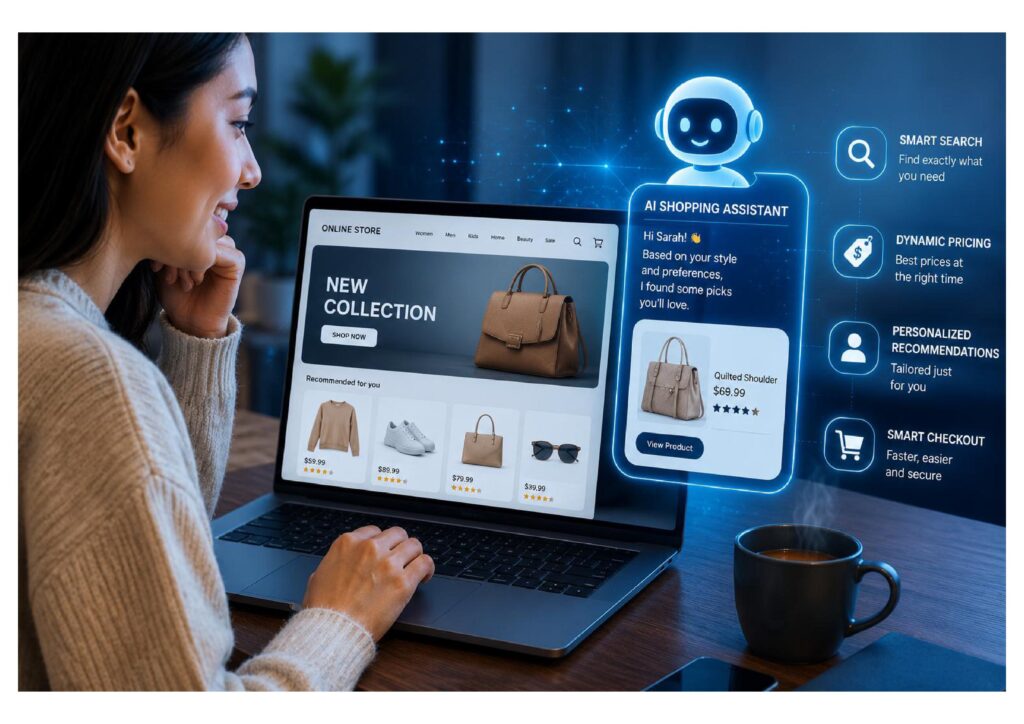



How AI is Changing the Way We Shop Online
Artificial intelligence is revolutionizing how AI is changing the way we shop online, automating customer service, optimizing pricing strategies, and predicting consumer behavior with unprecedented accuracy. From virtual try-on features to intelligent product recommendations, AI technologies are reshaping every touchpoint of the online shopping journey, making it faster, more intuitive, and highly customized to individual preferences.
TL;DR Summary
- AI-powered personalization engines analyze browsing patterns and purchase history to deliver tailored product recommendations, increasing conversion rates by up to 300%
- Chatbots and virtual assistants provide 24/7 customer support, handling 80% of routine inquiries without human intervention while improving response times
- Computer vision technology enables visual search, virtual try-ons, and automated inventory management, transforming how consumers discover and evaluate products online
What is AI in Online Shopping?
AI in online shopping refers to the application of machine learning algorithms, natural language processing, computer vision, and predictive analytics to enhance the e-commerce experience. These technologies work behind the scenes to understand customer preferences, automate decision-making processes, and create seamless shopping journeys that adapt in real-time to user behavior.
AI-Extractable Definition: AI in online shopping is the use of intelligent algorithms to personalize product discovery, automate customer interactions, and optimize the entire purchasing process based on data-driven insights.
Key Concepts
Personalization Engines: Machine learning systems that analyze customer data including browsing history, purchase patterns, demographic information, and real-time behavior to create individualized shopping experiences. These engines power product recommendations, customized email campaigns, and dynamic website content that adapts to each visitor.
Conversational AI: Natural language processing technology that enables chatbots and virtual shopping assistants to understand customer queries, provide product information, process orders, and resolve issues through text or voice interactions. These systems learn from each conversation to improve accuracy and relevance over time.
Computer Vision: AI technology that interprets visual information to enable features like visual search (finding products from uploaded images), virtual try-on experiences, and automated product tagging. This technology bridges the gap between physical and digital shopping by allowing customers to interact with products visually.
Predictive Analytics: Algorithms that forecast future consumer behavior, demand patterns, and market trends by analyzing historical data. Retailers use these insights for inventory optimization, dynamic pricing, and targeted marketing campaigns that anticipate customer needs before they’re explicitly expressed.
Dynamic Pricing: AI-driven systems that automatically adjust product prices in real-time based on demand fluctuations, competitor pricing, inventory levels, customer segments, and external factors like seasonality or market conditions to maximize revenue and competitiveness.
Step-by-Step Process
- Data Collection and Integration: AI systems gather data from multiple touchpoints including website interactions, mobile app usage, purchase history, customer service conversations, and third-party sources. This information is consolidated into unified customer profiles that serve as the foundation for all AI-driven personalization efforts.
- Pattern Recognition and Segmentation: Machine learning algorithms analyze collected data to identify behavioral patterns, preferences, and customer segments. The system recognizes correlations between products, identifies shopping triggers, and categorizes users into micro-segments for targeted experiences.
- Recommendation Generation: Based on identified patterns, AI engines generate personalized product suggestions using collaborative filtering (what similar customers bought), content-based filtering (products similar to previous purchases), or hybrid approaches that combine multiple methodologies for optimal accuracy.
- Real-Time Optimization: As customers interact with the platform, AI systems continuously adjust recommendations, search results, and content presentation. A/B testing algorithms automatically determine which layouts, messaging, and product placements perform best for different user segments.
- Automated Customer Support: When customers need assistance, AI-powered chatbots handle initial inquiries, routing complex issues to human agents while resolving routine questions instantly. Natural language understanding improves with each interaction, expanding the bot’s capability over time.
- Post-Purchase Engagement: AI continues working after checkout by predicting optimal delivery routes, sending personalized follow-up communications, identifying potential return risks, and recommending complementary products based on purchase history to encourage repeat business.
Real-World Examples & Scenarios
Scenario 1: Amazon’s Anticipatory Shipping: Amazon uses predictive AI to forecast what products customers in specific regions will likely purchase before they even search for them. The system analyzes browsing patterns, wish lists, and seasonal trends to pre-position inventory in nearby warehouses. This reduces delivery times dramatically—sometimes shipping products to local distribution centers before the customer clicks “buy,” enabling same-day or next-day delivery that would otherwise be impossible.
Scenario 2: Sephora’s Virtual Artist: Sephora’s AI-powered app uses augmented reality and computer vision to let customers virtually try on thousands of makeup products using their smartphone camera. The technology maps facial features in real-time, accurately rendering how different lipstick shades, eyeshadows, and foundations would look on the user’s actual face. This innovation reduced return rates by 25% while increasing customer confidence in online cosmetics purchases.
Scenario 3: Stitch Fix’s Algorithmic Styling: This online personal styling service combines AI algorithms with human stylists to curate personalized clothing selections. Customers complete detailed style profiles, and machine learning models analyze body measurements, style preferences, price sensitivity, and feedback from previous shipments. The AI narrows down millions of possibilities to a manageable selection that human stylists refine, creating a hybrid approach that delivers 85% customer satisfaction rates.
Scenario 4: ASOS’s Visual Search: Fashion retailer ASOS implemented AI-powered visual search allowing customers to upload photos of clothing they like from any source—social media, street photography, or magazine images. The computer vision system identifies similar items in ASOS’s inventory based on color, pattern, style, and silhouette, helping customers find products they couldn’t easily describe with text searches.
AI Technology Comparison in E-Commerce
| AI Technology | Customer Impact | Implementation Difficulty |
|---|---|---|
| Product Recommendation Engines | 15-30% increase in average order value; highly personalized shopping experience | Medium – requires substantial customer data and ongoing algorithm refinement |
| Chatbots & Virtual Assistants | Instant 24/7 support; 70% faster response times for common queries | Low to Medium – pre-built platforms available but customization requires expertise |
| Visual Search & AR Try-On | Reduces purchase hesitation; 40% reduction in returns for applicable products | High – requires advanced computer vision models and significant technical resources |
| Dynamic Pricing Algorithms | Optimizes revenue and competitiveness; may create price sensitivity concerns | High – complex modeling requiring market data, competitor monitoring, and ethical considerations |
| Predictive Analytics | Anticipates needs before customer awareness; improves inventory availability | Medium to High – depends on data quality and integration across systems |
| Fraud Detection Systems | Protects customer data; reduces fraudulent transactions by 50-90% | Medium – established solutions exist but require continuous updating |
Common Mistakes & Misconceptions
- Over-Reliance on Automation Without Human Oversight: Many retailers implement AI systems and assume they’ll work perfectly without monitoring. AI algorithms how AI is changing the way we shop online, make errors with edge cases, or create frustrating customer experiences when they misinterpret context. Successful implementations balance automation with human review, especially for customer-facing interactions and pricing decisions.
- Ignoring Privacy Concerns and Transparency: Collecting extensive customer data for AI personalization without clear communication creates distrust. The misconception that customers will accept any level of data collection for convenience has led to backlash. Best practices include transparent data policies, opt-in mechanisms, and giving customers control over their information.
- Expecting Immediate ROI: AI systems require time to collect sufficient data, learn patterns, and optimize performance. Companies often abandon AI initiatives prematurely when they don’t see instant results. Most successful AI implementations show modest improvements initially, with significant gains appearing after 6-12 months of continuous learning and refinement.
- Creating Filter Bubbles: Over-personalization can trap customers in recommendation loops where they only see products similar to past purchases, limiting discovery of new categories. Effective AI balances personalization with serendipitous discovery, introducing novel products that expand rather than narrow customer horizons.
- Neglecting Mobile Optimization: Implementing sophisticated AI features that work beautifully on desktop but poorly on mobile devices misses the reality that over 70% of e-commerce traffic comes from smartphones. AI-powered features must be designed mobile-first to reach the majority of online shoppers.
Pro Tips & Advanced Insights
- Implement Progressive Personalization: Start with basic segmentation and simple recommendation algorithms, then gradually increase sophistication as you collect more data. Use A/B testing to validate that each enhancement actually improves conversion rates before full deployment. This approach minimizes risk while building organizational expertise in AI implementation.
- Combine AI with Emotional Intelligence: The most successful e-commerce platforms use AI to handle data-intensive tasks while preserving human touchpoints for emotionally complex situations. Train AI systems to recognize when customers are frustrated, confused, or dealing with sensitive issues, then seamlessly transfer them to human agents who can provide empathy alongside solutions.
- Leverage AI for Inventory Forecasting: Advanced retailers use machine learning to predict demand at granular levels—specific products, sizes, and colors by geographic region and time period. This reduces overstock by 20-30% while improving in-stock rates for high-demand items, directly impacting both costs and customer satisfaction.
- Create Feedback Loops: Design systems where customer actions (purchases, returns, reviews, support inquiries) automatically feed back into AI models to improve future predictions. Explicit feedback mechanisms like “why are you returning this?” or “rate this recommendation” provide valuable training data that passive observation cannot capture.
- Use AI for Competitive Intelligence: Deploy price monitoring algorithms that track competitor pricing, promotional strategies, and inventory availability in real-time. Combine this with your own demand elasticity data to make informed pricing decisions that balance competitiveness with profitability rather than simply matching competitor prices.
- Optimize for Voice Commerce: As voice-activated shopping grows, ensure your AI systems are optimized for natural language queries rather than just keyword searches. This requires different algorithms that understand conversational context, handle ambiguity, and ask clarifying questions when needed.
Frequently Asked Questions
How does AI personalize my online shopping experience?
AI analyzes your browsing history, past purchases, items you’ve viewed, time spent on pages, and demographic data to create a unique profile. Machine learning algorithms then predict which products you’re most likely to purchase and customize website content, search results, email recommendations, and promotional offers specifically for you, creating a shopping experience tailored to your individual preferences and behaviors.

Are AI chatbots replacing human customer service representatives?
AI chatbots handle routine inquiries like order tracking, return policies, and product specifications, managing approximately 80% of standard customer service questions. However, they complement rather than replace human agents, who focus on complex issues requiring empathy, judgment, and creative problem-solving. Most effective systems use AI for initial contact and seamlessly transfer complicated situations to human representatives.
Can AI predict what I want to buy before I know it myself?
Advanced predictive analytics can identify patterns suggesting future purchases based on life events, seasonal patterns, and behavioral signals. For example, AI might predict you’ll need baby products after detecting searches for maternity items, or suggest winter clothing before you actively search based on weather patterns and past buying cycles. Accuracy varies but continues improving as algorithms become more sophisticated.
How does visual search technology work in online shopping?
Visual search uses computer vision and deep learning to analyze uploaded images and how AI is changing the way we shop online, identifying objects, colors, patterns, and styles. The AI compares these visual features against product databases to find matching or similar items. Advanced systems can even isolate specific items in complex images—like identifying a particular dress someone is wearing in a group photo—and locate purchasable alternatives.
Is dynamic AI pricing fair to consumers?
Dynamic pricing adjusts costs based on demand, inventory, and market conditions, similar to airline tickets or hotel rooms. While controversial, ethical implementations focus on market factors rather than individual customer exploitation. Transparency is key—responsible retailers explain pricing variations and avoid discriminatory practices. Regulations increasingly require fairness in algorithmic pricing to protect consumers from predatory practices.
What data does AI collect about my shopping habits?
AI systems typically collect browsing history and how AI is changing the way we shop online, search queries, products viewed, purchase history, cart abandonment data, device information, location data, email engagement, and customer service interactions. This data creates comprehensive profiles enabling personalization. Reputable retailers anonymize data, provide privacy controls, and comply with regulations like GDPR and CCPA, allowing customers to access, modify, or delete their information.